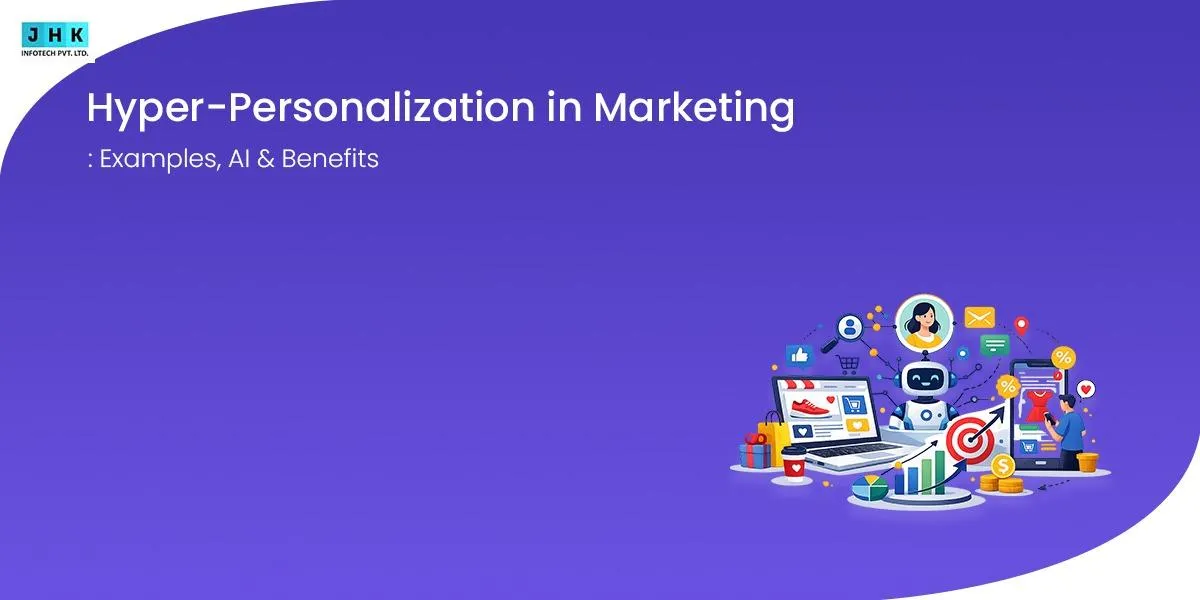
Hyper-Personalization in Marketing: Examples, AI & Benefits
In today’s highly competitive digital environment, generic marketing strategies are no longer effective. Users expect brands to understand their preferences, behavior, and intent—in real time. This shift has led to the rise of hyper-personalization in marketing, a strategy that uses AI, data, and automation to deliver highly tailored experiences to individual users.
This guide explains what hyper-personalization is, how it works, real-world examples, benefits, tools, and how businesses can implement hyper-personalized marketing effectively.
What Is Hyper-Personalization?
Hyper-personalization is an advanced marketing approach that uses artificial intelligence (AI), machine learning, and real-time data to deliver highly customized content, offers, and experiences to each individual user.
Unlike traditional personalization—which relies on basic data such as name, location, or past purchases—hyper-personalization analyzes live behavioral data, contextual signals, and predictive insights to decide:
- What content to show
- When to show it
- On which channel
- In what format
The goal is to create a one-to-one marketing experience at scale, making users feel understood rather than targeted.
Personalization vs Hyper-Personalization
| Aspect | Personalization | Hyper-Personalization |
|---|---|---|
| Data Used | Basic profile data | Real-time behavioral data |
| AI Use | Minimal | Heavy, predictive AI |
| Targeting | Broad segments | Individual user level |
| Outcome | Improved relevance | Deep engagement + conversions |
| Examples | “Hi John” email | Content changed based on user history + time + device |
How AI Enables Hyper-Personalization in Marketing
Artificial intelligence is the foundation of hyper-personalized marketing. Without AI, it would be nearly impossible to analyze vast amounts of user data, interpret behavioral patterns, and respond to individual users in real time. Modern digital platforms generate millions of signals every second, and AI makes sense of this complexity by transforming raw data into actionable insights that drive personalized experiences.
At the core of this process are machine learning models that continuously learn from user behavior. These models analyze past interactions and real-time actions to predict user intent and likely next steps. For example, AI can identify whether a visitor is researching, comparing options, or ready to convert, and then adjust the content or offer accordingly. As more data is collected, these predictions become increasingly accurate, allowing personalization to improve automatically over time.
Behavioral analytics plays a crucial role in understanding how users interact with digital experiences. AI tracks signals such as clicks, scroll depth, time spent on pages, navigation paths, and interaction frequency. Instead of viewing these actions in isolation, AI evaluates them collectively to understand engagement patterns. This allows marketers to personalize experiences based on how users behave, not just who they are.
Another powerful capability of AI is predictive personalization. Rather than reacting after a user takes action, AI anticipates what they are likely to need next. By analyzing patterns across similar users and historical data, AI can recommend content, products, or services before the user actively searches for them. This creates smoother, more intuitive journeys and reduces friction in the decision-making process.
Natural language processing (NLP) enables AI to personalize communication at a deeper level. NLP analyzes language, tone, and sentiment to tailor messaging that feels more human and relevant. This allows brands to adjust content tone, headlines, email copy, and chatbot responses based on user preferences, engagement history, or emotional cues, making interactions feel more natural and less automated.
Finally, automation engines connect AI insights with real-time execution. Once AI determines the best action for a user, automation systems instantly trigger personalized responses across channels such as websites, email, mobile apps, and advertising platforms. This ensures that personalization happens immediately, without manual intervention, and remains consistent across the entire customer journey.
Real-Time Personalization and Customer Experience
Real-time personalization focuses on adapting experiences instantly as users interact with a website, app, or platform.
Examples of Real-Time Personalization
- Changing homepage content based on traffic source
- Updating product recommendations as users browse
- Showing different CTAs based on user intent
- Adjusting messaging based on device, location, or time
Impact on Customer Experience Personalization
Real-time personalization significantly improves:
- Engagement time
- Conversion rates
- User satisfaction
- Brand loyalty
When users see relevant content instantly, the experience feels effortless and intuitive.
To successfully deploy hyper-personalized marketing experiences, many organizations rely on professional AI-driven marketing services that combine automation, data, and intelligence.
Benefits of Hyper-Personalization
Hyper-personalization delivers clear and measurable value by aligning marketing efforts with real user intent. By using real-time data and AI-driven insights, brands can create experiences that feel relevant, timely, and meaningful across every touchpoint.
Higher conversion rates are one of the most immediate benefits. When users see content, offers, or recommendations that match their current needs and behavior, they are more likely to take action, whether that means making a purchase or signing up for a service.
Improved customer engagement follows naturally from relevance. Hyper-personalized experiences keep users interested for longer periods, encouraging deeper interaction while reducing bounce rates and abandoned sessions.
Better customer retention is achieved when users feel recognized and valued. Personalized journeys build familiarity and trust, making customers more likely to return and continue engaging with the brand over time.
Increased marketing ROI comes from precision. AI-driven personalization minimizes wasted impressions and spend by targeting users with content that has a higher probability of converting.
Stronger brand relationships are the long-term outcome. Instead of feeling pushed by generic marketing messages, customers feel understood, which strengthens loyalty and brand perception.

Hyper-Personalization Examples Across Industries
E-commerce
- Personalized product recommendations
- Dynamic pricing or offers
- Customized landing pages for returning users
SaaS & B2B
- Role-based dashboards
- Personalized onboarding flows
- Content recommendations based on funnel stage
Digital Marketing & SEO
- Dynamic CTAs for different user segments
- Personalized content blocks
- Geo-targeted content experiences
Mobile Apps
- Adaptive UI based on usage behavior
- Personalized push notifications
- AI-driven onboarding sequences
These examples show how hyper-personalization adapts across industries and platforms.
Hyper-Personalization Software and Tools
Implementing hyper-personalization effectively requires a well-integrated technology stack that can collect data, analyze behavior, and deliver personalized experiences in real time. These tools work together to ensure personalization is accurate, scalable, and consistent across channels.
Hyper-personalization software acts as the central engine that analyzes user data and determines what content, offer, or message should be shown to each individual. These platforms rely heavily on AI and machine learning to adapt experiences dynamically rather than relying on fixed rules.
Personalization platforms focus on delivering tailored experiences across websites, apps, email, and advertising channels. They enable marketers to personalize layouts, content blocks, recommendations, and calls to action based on user behavior and intent.
AI personalization tools provide predictive capabilities such as product recommendations, content suggestions, and next-best-action insights. These tools continuously learn from user interactions, allowing personalization accuracy to improve over time without constant manual optimization.
Marketing automation personalization systems connect AI insights with execution. They automatically trigger personalized emails, push notifications, in-app messages, and ad experiences at the right moment, ensuring consistency across the customer journey.
Customer Data Platforms (CDPs) unify data from multiple sources such as websites, apps, CRM systems, and analytics tools. By creating a single customer view, CDPs ensure personalization decisions are based on complete and accurate first-party data.
When evaluating these tools, businesses should prioritize real-time data processing, AI-driven recommendations, and cross-channel personalization to deliver seamless experiences. Strong CRM and CMS integration ensures personalization extends across content and customer relationships, while privacy and consent management is essential for maintaining trust and regulatory compliance.
With the right tools in place, businesses can scale hyper-personalization efficiently, delivering highly relevant experiences without increasing manual effort or operational complexity.
How to Get Started With Hyper-Personalized Marketing
Getting started with hyper-personalized marketing does not require a complete overhaul of your existing systems. Instead, it works best when implemented gradually and aligned with clear business goals.
The first step is to collect first-party data responsibly. This includes insights from website analytics, CRM systems, email interactions, and on-site behavior. Focusing on first-party data ensures accuracy, improves personalization quality, and helps maintain compliance with privacy regulations.
Next, shift your segmentation approach from demographics to behavior-based segmentation. Rather than grouping users by age or location, analyze how they interact with your brand—what pages they visit, how often they engage, and where they drop off. Behavioral data offers deeper insight into a user’s intent and their likelihood of taking action.
It is important to start with a single channel before expanding. Many businesses begin with website personalization, email marketing, or mobile apps, where personalization impact is easier to measure. This allows teams to test strategies, learn quickly, and refine personalization logic without unnecessary complexity.
AI should be introduced incrementally, not all at once. Begin with simple AI-driven recommendations or automated triggers, then expand into predictive personalization as confidence and data maturity grow. This reduces risk while allowing systems to learn and improve naturally over time.
Finally, continuously measure and optimize performance. Track key metrics such as engagement, conversions, retention, and customer lifetime value. Regular analysis helps identify what works, what doesn’t, and where personalization can be improved. When applied strategically and ethically, hyper-personalization becomes a sustainable growth engine rather than a one-time marketing tactic.

Final Thought
Hyper-personalization in marketing is no longer optional—it is becoming the standard for delivering meaningful digital experiences. By combining AI, real-time personalization, and customer experience personalization, businesses can create relevant, scalable, and high-converting interactions across channels.
Brands that invest in hyper-personalized marketing today will gain a long-term competitive advantage in engagement, loyalty, and revenue.
FAQ’s
1. What is hyper-personalization?
Hyper-personalization uses AI and real-time data to deliver individualized content and experiences tailored to user behavior and intent.
2. How does hyper-personalization differ from personalization?
Traditional personalization relies on basic data (like names). Hyper-personalization uses deeper behavioural insights and AI to tailor content at an individual level.
3. Can small businesses use hyper-personalization?
Yes — many AI tools and automation platforms now offer affordable features that help even small teams deliver personalized experiences.
4. What are some hyper-personalization examples?
Dynamic websites, predictive product recommendations, real-time messaging, targeted ads, and customized email content.
5. Is AI necessary for hyper-personalization?
AI is essential for scaling and analyzing large real-time datasets, which enables predictive and adaptive personalization.
6. What tools help with hyper-personalization?
AI personalization tools, personalization platforms, and hyper-personalization software in CRM and automation systems.
Recent Post
-
September 16, 2026
Multimodal AI: How AI Is Learning to See, Hear, Speak and Understand
-
September 11, 2026
AI Employees: How Businesses Are Building Digital Workforces in 2026
-
September 7, 2026
What Is GEO? The Future of SEO in the Age of AI Search
-
-
February 26, 2026
AI Trends 2026: Latest AI Innovation, Developments & Predictions